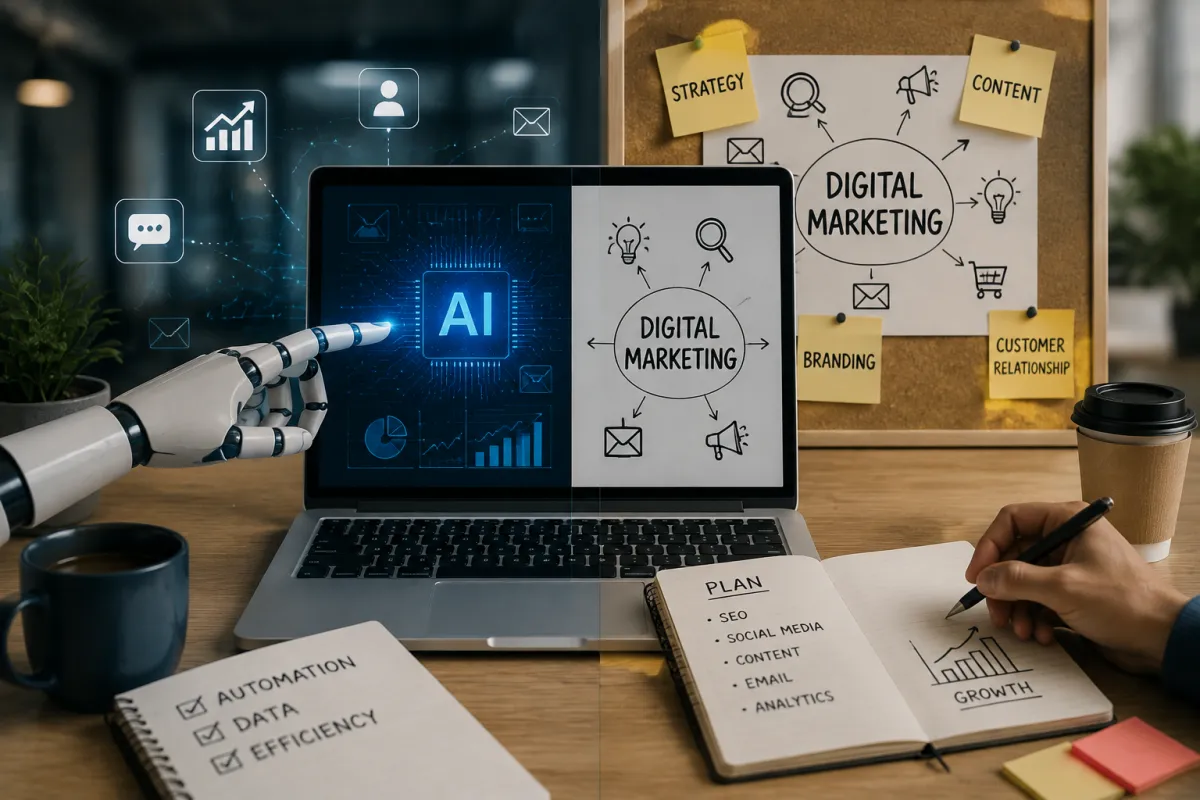
Will AI Replace Traditional Digital Marketing for Small Businesses?
Artificial intelligence is changing the way businesses handle marketing. Small businesses can now use AI tools to create content, review data, answer customer questions, generate ideas, and automate routine tasks that once took hours.
That change has led to a common question: Will AI replace traditional digital marketing for small businesses?
The short answer is no. AI is changing how marketing is done, but it is not replacing the people, local knowledge, strategy, and customer understanding that make a marketing campaign work.
For a small business, the better question is how AI can work alongside a marketing team. A smart combination of technology and human judgment can help a company save time while still building real relationships with customers.
Businesses researching a marketing agency Middlefield MA should look for professionals who understand both modern AI tools and the basics of effective digital marketing.
How Is AI Changing Digital Marketing?
AI can handle many repetitive marketing tasks. It can help organize large amounts of information, identify patterns, create content drafts, summarize reports, and suggest ideas based on customer behavior.
For a small business owner, this can be useful because there is rarely enough time to manage every marketing task manually.
AI can assist with:
Content ideas
Keyword research
Customer data analysis
Email drafts
Social media planning
Ad copy variations
Website content
Basic reporting
Customer support
Marketing automation
However, producing something quickly does not always mean producing something useful.
A business still needs a person who understands its customers, products, competitors, and goals.
Why Human Strategy Still Matters
Marketing is more than publishing content or placing advertisements. A business needs to know why a customer should choose it instead of another company. It needs a clear message and a reason for people to trust the brand.
AI can suggest several marketing messages, but a business owner or experienced marketer must decide which message actually sounds right for the company. Consider a local contractor.
An AI tool can create a general article about home repairs. But someone familiar with the local market can explain the problems homeowners actually face, the types of properties common in the area, and the questions customers ask before hiring a contractor. That local understanding makes content more useful.
Can AI Replace SEO?
AI has changed SEO, but it has not made SEO unnecessary. Search engines continue to evaluate many signals when determining which pages should appear for a query. Businesses still need useful content, technically sound websites, relevant pages, strong internal linking, good user experience, and information that meets search intent.
AI can help with research and content planning, but blindly publishing AI generated pages is not a complete SEO strategy.
A strong SEO service should focus on what potential customers are searching for and why they are searching for it.
For example, someone searching for a local plumber may want pricing information, service availability, emergency help, or answers to a specific plumbing problem. A generic article may not satisfy that person. Good SEO starts with understanding the searcher.
Why Local SEO Still Needs Human Input
Local businesses have a special advantage. They know their community. A local restaurant knows which customers visit during lunch. A remodeling company knows the types of homes it works on. A professional office understands the questions people ask before booking an appointment.
AI can organize this information, but it does not automatically know the real experiences of the business. This is where a local marketing strategy becomes useful.
An SEO agency in Middlefield can combine local research with technology to create content that is more closely connected to the needs of people searching in the area.
Can AI Create Better Content?
AI can create content quickly. That does not mean every piece of AI content is good. Readers can notice when an article feels generic. They may also lose interest when every paragraph sounds the same or when the content gives broad advice without practical examples.
Good business content should answer real questions. It should explain things clearly and give readers a reason to trust the company.
AI can help create the first draft, organize ideas, or find missing topics. A human writer can then improve the information, add relevant examples, remove unnecessary wording, and make sure the content fits the brand.
This combination can be much more useful than depending entirely on automation.
What About Social Media Marketing?
Social media is another area where AI can save time. Businesses can use AI to generate post ideas, create captions, organize calendars, and review performance data. But social media is still about people.
Customers may comment on a post, ask a question, complain about a service, or share an experience. A real person needs to understand the situation and respond appropriately.
A business that uses automated replies for every interaction can end up sounding disconnected. AI can support social media management, but human communication remains important.
Can AI Replace Google Ads Management?
AI has become an important part of online advertising. Advertising platforms use automation to help with bidding, targeting, audience selection, and campaign optimization.
Businesses can also use AI to create different ad variations and analyze campaign data.
Still, someone needs to decide:
Who the business wants to reach
Which services should be promoted
What budget makes sense
Which landing pages should be used
What makes the offer attractive
Which results actually matter
Automation can make campaign management faster, but it does not remove the need for marketing decisions.
Where Can Small Businesses Benefit Most From AI?
Small businesses often have limited staff and limited time. That makes automation particularly useful. AI can help reduce the amount of time spent on repetitive work. A business owner can use that extra time for sales, customer service, operations, or other important responsibilities.
Some practical uses include:
Creating a first draft of a blog
Summarizing analytics reports
Generating email ideas
Organizing customer questions
Finding content gaps
Creating ad variations
Brainstorming social media topics
Reviewing large sets of marketing data
The goal should not be to replace every human task. The goal should be to remove unnecessary manual work.
What Are the Risks of Relying Too Much on AI?
AI is not perfect. It can produce incorrect information, repeat common ideas, misunderstand a question, or create content that sounds convincing but lacks accuracy.
This can be a serious problem for businesses. Incorrect information on a website can damage trust. Poorly researched content can also make a company look less professional.
That is why every important piece of marketing content should be reviewed before publication.
A human should check facts, tone, brand details, local information, and the overall usefulness of the content.
Will Customers Notice AI Generated Marketing?
Sometimes they will. Customers are exposed to a large amount of online content every day. Generic wording, repetitive ideas, and unnatural responses can make a business appear less personal. People want answers that relate to their situation.
For example, a local customer may not care about a broad explanation of a product. They may want to know whether the company serves their area, how quickly it can help, what the process involves, and what they should expect. Good marketing addresses those concerns directly.
What Should Small Businesses Do Now?
Small businesses do not need to choose between AI and traditional marketing. They can use both. A practical approach is to divide marketing work into tasks that benefit from automation and tasks that require human judgment.
Use AI for Repetitive Work
Let technology help with research, organization, drafts, summaries, and data analysis.
Keep Humans Involved in Strategy
Marketing goals, brand positioning, customer relationships, and important decisions should still receive human attention.
Review Everything Before Publishing
Check AI assisted content for accuracy and usefulness.
Focus on Customer Questions
Use real customer questions to guide content instead of creating pages simply because an AI tool suggested a topic.
Measure Business Results
Traffic is useful, but businesses should also look at leads, calls, appointments, sales, and other meaningful outcomes.
Does AI Make Digital Marketing Less Expensive?
It can reduce certain costs. AI can speed up research, content drafting, reporting, and other repetitive tasks. This may allow a small team to accomplish more without adding staff for every task.
However, lower production costs do not automatically mean better marketing. A business can produce hundreds of pages quickly, but if those pages do not attract the right customers, the effort has little value.
The focus should remain on results rather than volume.
What Will Digital Marketing Look Like in the Future?
Digital marketing will likely become more automated, but that does not mean human marketers will disappear. Instead, their role may change.
Marketers will spend less time on repetitive tasks and more time on strategy, creative decisions, customer research, brand development, and interpreting information.
Businesses that learn how to use AI responsibly may have an advantage because they can work faster while keeping human oversight.
The companies that struggle may be those that treat AI as a replacement for marketing rather than as a tool that supports it.
Conclusion
Will AI replace traditional digital marketing for small businesses? Not completely. AI will change how marketing work is planned, created, measured, and managed, but businesses will still need people who understand customers and know how to turn information into a clear strategy. For companies considering a marketing agency Middlefield MA, the strongest approach is to combine useful AI tools with experienced marketing guidance, local knowledge, and careful human review.
We Market MA provides professional digital marketing services designed to help businesses build a stronger online presence. By combining modern marketing tools with practical strategy, the company can help businesses make better use of SEO, content, advertising, and other digital channels.
Frequently Asked Questions
Will AI completely replace digital marketing?
No. AI can automate many marketing tasks, but businesses still need strategy, customer knowledge, creativity, local insight, and human judgment.
Can small businesses use AI for SEO?
Yes. AI can help with research, topic planning, content drafts, and data analysis. However, SEO still requires a broader strategy based on search intent, website quality, useful content, and business goals.
Is AI generated content good for SEO?
AI generated content can be useful when it provides accurate and helpful information. Simply publishing large amounts of generic content is not a reliable SEO strategy.
Should a small business hire a marketing agency if it uses AI?
It can still make sense. An experienced agency can help choose the right tools, create a marketing strategy, review results, and make decisions that automation alone cannot handle.
Can AI manage Google Ads?
AI can assist with bidding, targeting, optimization, and ad creation. Human oversight is still useful for budgets, offers, landing pages, audience strategy, and campaign goals.
What is the biggest benefit of AI for small businesses?
Time savings are one of the biggest benefits. AI can handle repetitive tasks so business owners and marketing teams can focus on customers and higher value work.
What is the biggest risk of using AI in marketing?
Overreliance is a major risk. Businesses that publish unchecked information or use generic automated communication can lose credibility with customers.
